
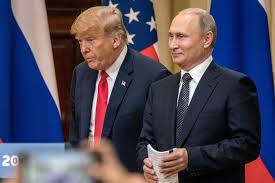
 Observers are correct to condemn both Russian efforts to influence our presidential elections and President Trump’s failure to reject those efforts. But it is wrong to suggest that all efforts by foreign governments to influence our elections are improper. The question is not whether other countries are trying to exert influence, but whether they are doing so by legitimate means.
Continue Reading Presidential Elections and Foreign Influence–Not Always Improper
President Trump, Congress, and Checks and Balances
 Punitive tariffs, arms sales, border wall funding, and more. Donald Trump regularly finds ways to pursue his policy preferences over the clear opposition of Congress. This is especially troubling since decisions on these matters are properly within the constitutional authority of the legislative branch.
As many political observers have observed, Congress has abdicated its policy making responsibilities by delegating immense amounts of power to the executive branch, and it needs to assert its authority and live up to its constitutional role. But while it is correct to promote a return to core constitutional values, we cannot rely on the virtue of our elected officials to do the right thing. Congress has defaulted on his constitutional duties for more than a century; there is no reason to think it will change. Indeed, our Constitution is premised on that reality.Continue Reading President Trump, Congress, and Checks and Balances
Robert Mueller and Impeachment
 How does Special Counsel Robert Mueller’s public statement change the impeachment question? Not very much. He confirmed what we already knew from his report:
- If he had been confident that President Trump did not commit the crime of obstructing justice, he would have said so.
- He didn’t consider bringing charges against Trump because under longstanding Department of Justice policy, it is unconstitutional to file criminal charges against a sitting President.
- The proper way to hold the Trump accountable for his conduct is either through criminal charges after he leaves office or the impeachment process while he still holds office.
Does the Mueller Report justify impeachment?Continue Reading Robert Mueller and Impeachment
Arms Sales and the Imperial Presidency
 Members of Congress have good cause to worry about the extent to which President Trump ignores legal constraints. But they also have given him plenty of authority to impose his will lawfully. Yesterday’s announcement of weapons sales to Saudi Arabia and other Middle East countries is illustrative. Even though the Constitution does not grant Presidents the power to make arms deals on their own, Congress has done so.
Continue Reading Arms Sales and the Imperial Presidency
President Trump and the Subpoena Power of Congress
 According to a federal district court, the subpoena power of Congress gives it access to President Trump’s personal financial records. While this is an important decision, it’s only a prelude to a decision on appeal. As we’ve seen before, the President sometimes prevails in the end after losing initially. And there are good arguments that the President’s lawyers can make to the U.S. Court of Appeals for the D.C. Circuit, and possibly the U.S. Supreme Court, to try to limit the scope of the subpoena.
Continue Reading President Trump and the Subpoena Power of Congress
President Trump and the Increasingly Conservative Courts of Appeal
 Historically, different U.S Courts of Appeal have varied in their ideological cast. The 9th Circuit, which covers California and other western states, has long leaned liberal while the 5th Circuit, which covers Texas, Louisiana, and Mississippi, has leaned conservative. But changes in the U.S. Senate approval process are giving President Trump the opportunity to bring a conservative tilt to all of the Courts of Appeal.
Continue Reading President Trump and the Increasingly Conservative Courts of Appeal
Trade Wars, Trump, and the Constitution
 Is Donald Trump’s trade war with China a shrewd tactic or a reckless gamble with the livelihoods of farmers, auto workers, and other Americans? Only time will tell.
But as we watch events unfold, we should remember why the Framers of the Constitution rested authority to “regulate commerce with foreign nations” in Congress rather than with the President. The constitutional drafters understood that policy is best made by elected representatives who bring different perspectives to the table than by a single executive who has only one viewpoint. They also understood that executives are too willing to provoke conflict with other countries. The Framers wanted to make it difficult for their new government to act impulsively.
So how does Trump have the authority to levy harsh tariffs on goods imported from China?Continue Reading Trade Wars, Trump, and the Constitution
Executive Privilege and President Trump
 Can President Trump shield the redacted portions of the Mueller Report, prevent former White House Counsel Don McGahn from turning over documents, or deny other information to Congress by claiming executive privilege? Like many other legal questions, the devil is in the details.
The Supreme Court has addressed executive privilege, but not to a great extent, and it has established general principles rather than clear rules. A few considerations are important.Continue Reading Executive Privilege and President Trump
Venezuela, Trump, and the Constitution’s War Powers
 President Trump may prefer “strict constructionists” when it comes to Supreme Court Justices, but when it comes to his own power, he is more than willing to ignore the constitutional text. As recent statements by Secretary of State Mike Pompeo indicate, he and Trump believe the President can authorize military action in Venezuela to topple Nicolás Maduro. They’re wrong according to Article I of the Constitution and the Framers’ intent. Unfortunately, there’s ample precedent by Trump and his predecessors for presidential power to initiate conflict.
Continue Reading Venezuela, Trump, and the Constitution’s War Powers
The Census, Donald Trump, and the Supreme Court
 At oral argument last week, the Supreme Court seemed poised to side with President Trump on the question whether the U.S. Census Bureau can ask people if they are U.S. citizens. Critics have objected to inquiring about citizenship status, observing that doing so is likely to result in an undercount, since many non-citizens will decline to participate in the census. Other non-citizens are likely to answer untruthfully, rendering the data about citizenship inaccurate.
While the Court’s conservative ideological bias will be a key factor in the outcome, also critical is the extent to which Congress has delegated its policy making power to the White House and the extent to which the Court has been willing to allow the delegation. Previous Court decisions, supported by both conservative and liberal justices, provide the Court with ample basis for a pro-Trump decision.
Continue Reading The Census, Donald Trump, and the Supreme Court